

.svg)




Quintain is an award-winning property developer and asset manager focused on large-scale urban regeneration.
They are known for their work in Wembley Park, London Borough of Brent, where they transformed a former industrial area into a flourishing neighbourhood containing homes, shops and public spaces.
Quintain's strategy is centred on long-term investment, typically retaining ownership of their developments and operating a build-to-rent model. This allows the business to manage quality, service, and community experience over time.
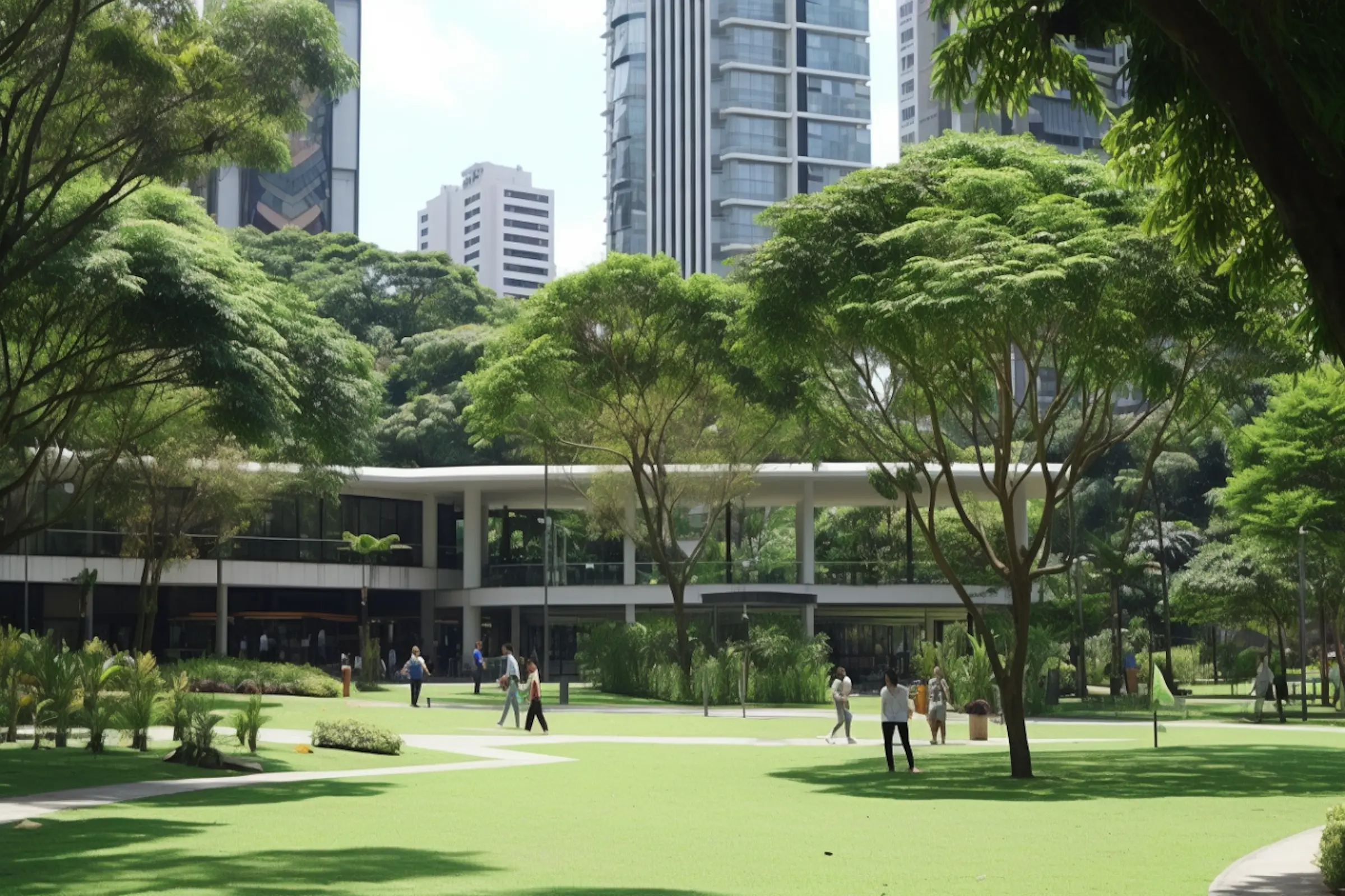
Their schemes are designed as mixed-use environments. Residential buildings integrate with retail, dining, and leisure, creating places where people can live, work, and spend time. A focus on the public realm integrates landscaped spaces with a regular programme of cultural and neighbourhood events.
Sustainability and design quality are important parts of their strategy. The business collects energy and water data from their property portfolio and keeps a robust carbon inventory, but wanted to improve the internal usability of all the data - so it could work not purely for reporting, but also advance their sustainability performance.
Tackling a dispersed data landscape
Quintain needed further expertise to optimise their sustainability data and processes. The internal sustainability team managed detailed datasets, but these were fragmented into manually maintained Excel spreadsheets. The data was invisible to most of the business, and stored in formats not usable for leadership purposes.
Accordingly, reporting expectations from external stakeholders could become increasingly difficult to address in future, with the potential the issue could evolve into a reputational risk.
The sustainability function was able to report externally and meet regulatory and compliance requirements, but an opportunity was identified to use the data to engage with the business in a more meaningful way.
From a corporate perspective, Quintain was experiencing limitations in being able to realise their sustainability ambitions. Quality data was required to reduce energy costs, while the potential to equip facility managers with skills to drive sustainable change at a day-to-day operational level remained untapped.

Embedding a new way of operating - a data transformation programme
Our solution encompassed a full process, data and technology overhaul. As a platform agnostic consultancy, we work with our clients’ preferred technology; for Quintain, we developed and launched a Power BI dashboard as a replacement for the fragmented email-and-spreadsheet pipeline. The platform covers energy, water, waste, and GHG by scope, building, and time period. Quintain is able to access the platform 24/7, independently, and slice and dice the data to serve them best across different users and departments.
We followed the Cambianz delivery model, with an initial discovery phase centred around an in-depth data audit, which revealed a number of business opportunities beyond the sustainability function. This insight led us to connect with internal teams across operations, finance, and sustainability to build and test the dashboard: a holistic stakeholder management plan supported by change management.
As the teams became familiar with the technology, they were able to contribute to each iteration of the Power BI dashboard in scenario-based sessions.
We then prepared the tool for deployment across the business, collaborated with the chief technology officer in the design of an app for future deployments, and held a series of C-suite and investor briefings to socialise the data at the board and private equity investor level.